The standards for green building are constantly evolving, pushing manufacturers and designers to innovate for a more sustainable future. With the introduction of LEED v5, the U.S. Green Building Council (USGBC) has set a new benchmark for environmental responsibility, focusing on decarbonization, resilience, and circularity. For building owners and facility managers aiming for the highest levels of certification, every component choice matters—especially in water efficiency.
To provide deeper insight into how plumbing technology aligns with these new standards, we spoke with Paul Sambanis, Vice President of Sustainability at Sloan. With his extensive expertise in sustainable building practices, Paul helps us explore the crucial connection between the Flushmate 503UH 0.75 gallons per flush (gpf) system and the ambitious goals of LEED v5.
How does the new LEED v5 framework raise the bar for sustainability, and where does a product like the Flushmate 503UH fit in?
LEED v5 represents a significant step forward. It’s not just about incremental improvements; it’s about driving toward a near-zero carbon future. The framework has a strong focus on impact categories like climate health, human health, ecosystem health, social equity, and the circular economy. This is where high-efficiency products become critical.
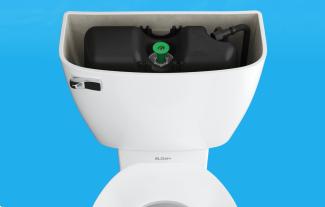
The Flushmate 503UH system, when paired with a Sloan 0.75 gpf toilet, directly addresses the water efficiency criteria, which remains a cornerstone of LEED. Achieving this ultra-low flush volume allows projects to secure the maximum points available in the Indoor Water Use Reduction category. For new construction, this can mean up to six points, and for interior design and construction, it can be up to 12 points. This capability is consistent from LEED v4.1 and remains essential for achieving higher certification levels under v5.
LEED v5 places a heavy emphasis on decarbonization. How does a water-saving toilet system contribute to reducing carbon emissions?
It’s a vital connection that is often overlooked. When you reduce water consumption, you also reduce the energy required to treat, pump, and distribute that water to a building. Furthermore, you lower the energy needed to treat the wastewater that leaves it. This entire process, known as the water-energy nexus, carries a significant carbon footprint.
By using only 0.75 gallons per flush—a 53% reduction compared to standard 1.6 gpf toilets—the Flushmate 503UH system substantially lowers a building's operational carbon emissions. While it seems like a small action, when you multiply that savings across thousands of flushes in a commercial building, the impact on energy and carbon reduction is immense. It's a clear example of how focusing on water conservation directly supports broader decarbonization goals.
You mentioned the circular economy. How is Flushmate aligning its product development with the principles of circularity and material health?
This is a major area of focus for us and a key pillar of LEED v5. We are actively reevaluating the materials used in our products to improve their end-of-life cycle. The goal is to move away from a linear "take-make-waste" model and toward a circular one where components can be reused, recycled, or disposed of with minimal environmental impact.
We are exploring the use of more bio-based materials and designing for disassembly. Additionally, to support transparency and help architects and specifiers make informed decisions, we are developing Environmental Product Declarations (EPDs). These EPDs, which we plan to release in 2026, will detail the carbon footprint associated with our raw materials, manufacturing, and transportation, helping projects earn additional points under the Building Product Selection and Procurement category in LEED v5.
Beyond water savings, what other performance features of the Flushmate 503UH system support sustainable building operations?
Sustainability isn't just about resource conservation; it's also about performance, durability, and resilience. A system isn't truly sustainable if it requires constant maintenance or fails to perform its basic function effectively. The pressure-assisted technology in the 503UH is engineered to ensure powerful evacuation and drainline carry, reaching up to 60 feet.
This superior performance reduces the frequency of clogs and stoppages, which means less downtime and lower maintenance costs. The fewer moving parts also contribute to its durability. From a resilience perspective, we are working to make our systems compatible with alternative water sources, like greywater. By enabling buildings to use reclaimed water for flushing, we can help reduce their reliance on the municipal grid, making them more self-sufficient and resilient.
LEED v5 also highlights quality of life and social equity. How does a toilet system impact the user experience and contribute to a healthier indoor environment?
The user experience is paramount. A common perception of pressure-assisted toilets is that they are loud. Our engineers have invested significant resources into acoustics, using advanced software and a reverberation chamber to design the quietest flush in the pressure-assist market. This is crucial for environments like hotels, multi-family residences, and healthcare facilities, where noise levels directly impact occupant comfort.
For health and hygiene, the powerful flush helps maintain a cleaner bowl with every use. The system is also compatible with touch-free flushing mechanisms like I-Flush™, which minimizes the spread of germs—a critical feature in any public restroom. By providing a reliable, quiet, and hygienic experience, the Flushmate 503UH contributes to the overall quality of life for building occupants, a key goal of LEED v5.
What is your final message to architects, engineers, and building owners pursuing LEED v5 certification?
My message is that every choice matters. Achieving top-tier LEED certification requires a holistic approach, and specifying high-performance, water-efficient plumbing is a foundational piece of that strategy. The Flushmate 503UH system offers a clear path to maximizing water efficiency credits while simultaneously supporting goals related to decarbonization, resilience, and occupant well-being. It’s a technology that proves you don’t have to compromise on performance to achieve exceptional sustainability. We are proud to provide solutions that not only meet today’s standards but also anticipate the needs of the future.