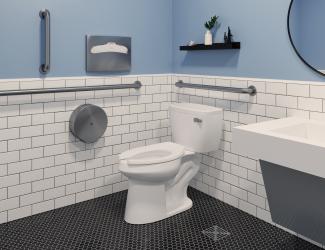
Malfunctioning toilets can cause a wide range of issues in commercial and residential facilities—from property damage and inflated utility costs to a poor guest experience. While traditional gravity toilets are commonplace in many facilities, they can sometimes fall short in delivering the performance and reliability needed to meet modern efficiency standards.
To explore a more powerful solution, we sat down with Rolando Zambrano, Sloan Product Line Manager, Flushometers and Fixtures. Sloan is the industry leader in commercial plumbing solutions, and their Pressure-assisted Toilets are powered by Flushmate technology. Below, Rolando breaks down how pressure-assist systems are engineered to optimize water savings, reduce maintenance, and provide consistent, high-performance flushing for all types of facilities.
Flushmate’s 503UH system uses just 0.75 gallons per flush while maintaining strong performance. What makes pressure-assist systems like Flushmate stand out in efficiency and effectiveness compared to gravity toilets?
Unlike gravity toilets that depend on the weight and volume of water to create a weak siphon, pressure-assist technology uses water pressure to provide a superior flush. Inside a Flushmate system, water enters a sealed vessel, compressing the air trapped inside. When the toilet is flushed, this stored energy is released, forcing water into the bowl and down the drain line at high velocity.
This creates a powerful push that evacuates waste far more effectively than gravity. The result is a stronger, quicker, and more hygienic flush that uses significantly less water. While a standard high-efficiency gravity toilet uses 1.28 gallons per flush (gpf), Flushmate systems achieve a complete, clog-free flush with as little as 0.75 gpf. It’s not just about using less water; it’s about making that water work smarter and harder.
Pressure-assist retrofits have been shown to reduce stoppages and save water. Can you share how this benefits property owners over time?
The long-term benefits for property owners are substantial, leading to a lower total cost of ownership. The first and most immediate benefit is the reduction in clogs. In high-traffic environments like hotels or multi-family housing, stoppages are a constant headache. With pressure-assist technology, customers report that clogs are virtually eliminated. This means fewer calls to plumbers, less downtime for restrooms, and higher user satisfaction.
Second, the benefits of water savings are significant. A single leaking gravity toilet can waste up to 200 gallons per day, adding up to thousands of dollars in utility bills over a year. Because Flushmate systems feature a sealed, non-corroding vessel, the common and costly leaks associated with flappers and fill valves are a thing of the past. When you combine water savings with the dramatic reduction in maintenance needs, the investment in a pressure-assist system pays for itself long-term.
Gravity toilets are improving, but where do pressure-assist systems still hold a clear advantage?
While gravity toilet manufacturers have made strides, pressure-assist systems maintain three key advantages: superior drain line carry, exceptional bowl cleanliness, and enhanced reliability.
- Drain Line Carry: Modern, low-flow gravity toilets can struggle to move waste through a building's plumbing, especially in older infrastructures not designed for such low volumes. Pressure-assisted toilets equipped with Flushmate systems can push waste up to 50% further than industry standards require, ensuring waste is completely removed from the building and preventing issues downstream.
- Bowl Cleanliness: The powerful flush of a pressure-assist system creates a natural scrubbing effect. The high-velocity water scours the bowl surface with each flush, keeping it cleaner for longer and reducing the labor and chemicals needed for manual cleaning. When paired with technologies like SloanTec® Glaze, which provides an even smoother, bacteria-resistant surface, the hygienic benefits are compounded.
- Reliability: Gravity toilets rely on components like flappers and chains that wear out, misalign, and cause leaks. The sealed Flushmate vessel has a much longer service life, delivering consistent performance year after year without needing constant adjustments.
Let’s address the noise. While pressure-assist systems are sometimes perceived as louder, how does their performance outweigh this concern?
The perception that pressure-assist systems are louder stems from the earliest models introduced nearly 40 years ago. While those first-generation systems were noisier, technology has advanced significantly. Modern pressure-assist systems, especially the latest Flushmate models paired with new bowl designs, are engineered to deliver enhanced performance while significantly reducing the flush sound compared to earlier models.
When you listen to a modern pressure-assisted toilet, you’ll notice the sound is different than a gravity flush, but not necessarily intrusive. The flush itself is quicker and more decisive than a gravity toilet. Furthermore, once the flush is complete, the system is silent. There is no continuous hiss of a slowly refilling tank, which can last for minutes with a gravity toilet. The brief, powerful flush and rapid, quiet refill make the overall experience more efficient and less disruptive, especially in commercial settings where stall turnover is important.
How do Flushmate systems perform in buildings with lower or fluctuating water pressure?
Flushmate systems are designed to operate reliably within a standard pressure window of 25-80 psi. This means they deliver a consistent, powerful flush even in buildings where water pressure might not be ideal for other types of fixtures.
For property owners, this consistency provides peace of mind. While a gravity toilet's performance can degrade with wear and tear, a pressure-assisted toilet delivers its rated flush volume every single time.
This reliability is crucial for saving money. You reduce your water bill, and because you're using less water, you also lower the associated sewer fees. A Flushmate system ensures you get the performance you expect while passing those operational savings directly to the building owner.
How do pressure-assisted toilets help businesses achieve sustainability goals, especially in large-scale installations?
For businesses pursuing LEED certification or other green building initiatives, pressure-assisted toilets are a powerful tool. By specifying ultra-high-efficiency toilets like Flushmate 503UH 0.75 gpf or 504 1.0 gpf models, architects and facility managers can earn valuable points toward water efficiency credits.
Beyond certifications, the impact on a company's environmental footprint is significant. A large-scale commercial retrofit from older 1.6 gpf toilets to a pressure-assisted toilet equipped with a Flushmate 503UH 0.75 gpf system can save thousands of gallons of water annually. This also reduces the energy consumed by municipal facilities to treat and pump that water. When you specify a product that is locally designed and assembled like Flushmate, you are also reducing the carbon footprint associated with transportation and supporting a more sustainable supply chain. It’s a holistic approach to building a more efficient and responsible facility.