As buildings transition to lower flush volumes, property managers and facility teams are increasingly focused on retrofit projects that reduce water use without sacrificing system reliability. Toilets play a critical role in overall building performance, yet many buildings still rely on fixtures and drainage systems designed around much higher flush volumes.
Flushmate pressure‑assist systems are engineered to address this challenge. Retrofit‑ready models such as the 504 (1.0 gpf) and 503H (1.28 gpf) combine lower water consumption with powerful, high‑velocity flushing to move waste farther down the drainline in one flush. This performance helps reduce clogs, minimize double flushing, and protect downstream plumbing.
To better understand why drainline carry plays an important role in toilet performance, we spoke with Jasris Jasnie, Flushmate’s Director of Engineering, about how pressure‑assist technology supports reliable retrofits, long‑term building health, and sustainable water use.
Why is drainline carry a critical but often overlooked aspect of toilet performance?
Most people evaluate toilet performance based on what they see in the bowl. If the bowl clears, the assumption is that the toilet is doing its job. The real question is what happens after the waste leaves the fixture.
Drainline carry measures how effectively a single flush transports waste through a building’s horizontal drainage piping. In many commercial and multifamily buildings, those drainlines are long, have minimal slope, and may receive limited supplemental water flow from other fixtures. If the toilet does not generate enough hydraulic energy, waste may travel only part of the way before settling in the pipe.
That buildup doesn’t cause immediate failure, which is why drainline carry is often overlooked, but over time it leads to clogs, odors, and recurring maintenance issues.
How does drainline carry directly impact long-term building health?
Poor drainline carry creates gradual, compounding problems within the drainage system. Waste that isn’t fully transported on each flush accumulates inside the piping instead of reaching the main stack or sewer connection.
Over time, that accumulation leads to partial blockages, biofilm buildup, and persistent odors that are difficult to trace back to a specific fixture. Maintenance teams experience an increase in drain-related service calls, requiring more attention to reactive service calls, snaking lines and addressing complaints without ever fully resolving the underlying issue.
While the toilet itself represents only a small portion of the overall plumbing system, it plays an important role in establishing the hydraulic energy that moves waste through the drainage network. When that initial transport energy is insufficient, downstream performance becomes inconsistent, making problems harder to detect, more costly to address, and more likely to persist over time.
What specific aspects of pressure-assist technology allow Flushmate to outperform gravity systems in drainline carry?
The primary difference is how flush energy is stored, released, and delivered. Gravity toilets rely on water falling from the tank, which produces a relatively slow discharge and relies heavily on siphon action to move waste.
Flushmate pressure-assist systems use the building’s water pressure to compress and store air inside a sealed vessel. When the toilet is flushed, stored energy is released instantly, driving water into the bowl at significantly higher velocity. This results in peak flow rates of approximately 70 gallons per minute (gpm), compared to roughly 20 to 30 gpm for typical gravity toilets.
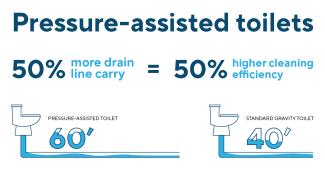
That higher velocity creates greater momentum, allowing waste to be pushed farther down the drainline in a single flush. While ASME drainline transport testing establishes a 40‑foot minimum carry requirement, Flushmate pressure-assist systems are engineered to exceed that baseline reaching up to 60 feet, often while using the same or less water than gravity fixtures.
What are the most common misconceptions engineers or specifiers have about drainline carry when selecting plumbing fixtures?
One of the most common misconceptions is assuming that flush volume and drainline carry are directly proportional. Using more water does not automatically translate to better waste transport. A 1.28‑gpf gravity toilet does not necessarily outperform a 1.0‑gpf pressure‑assist toilet simply because it uses more water. Velocity, momentum, and discharge profile play a much larger role in how far waste is carried through the system.
Another misconception is treating ASME drainline transport testing as a comprehensive measure of performance. In reality, the ASME test represents a minimum requirement. Passing it does not guarantee that a fixture will perform well in older buildings, long horizontal runs, or systems originally designed around higher flush volumes.
What operational benefits tend to show up first after switching to pressure-assist systems?
The most immediate benefit facilities teams tend to notice is a reduction in drain-related service calls. With stronger drainline carry, waste is fully transported on each flush rather than stopping partway down the pipe. This leads to fewer partial blockages, fewer slow drains, and less time spent snaking lines or responding to complaints. In many cases, these improvements become apparent within the first maintenance cycle following installation.
For property managers, this translates to lower maintenance costs, reduced downtime, and improved occupant satisfaction.
What excites you most about Flushmate’s ability to maintain strong drainline carry below 1.0 gpf?
From an engineering perspective, it’s the ability to challenge long-held assumptions about water use and performance. Historically, toilet performance has been evaluated based on water volume, with the assumption that greater volume is necessary to move waste effectively through the system.
Pressure-assist technology demonstrates that velocity and momentum matter more than volume alone. Maintaining strong drainline carry at sub‑1.0‑gpf flush volumes, without compromising downstream plumbing performance, is a difficult engineering challenge. Solving that challenge allows buildings to achieve meaningful water savings while still protecting their drainage systems, particularly in older properties and water-stressed markets.
How do you see drainline carry shaping future plumbing design, and what role will Flushmate play?
As codes continue to push flush volumes lower, drainline carry will become increasingly important, not just as a differentiator, but as a specification requirement.
At very low flush volumes, overall system hydraulics begin to play a larger role, including pipe slope, diameter, and the availability of supplemental flow from nearby fixtures. Flushmate’s role is to extend the viable lower limit of flush volume by delivering higher discharge velocity and consistent transport energy at the fixture level.
By reducing reliance on external factors and protecting downstream performance, Flushmate helps bridge the gap between aggressive water-efficiency goals and real-world plumbing system reliability.